
 "The truest expression of Classical Mechanics is in the machines we ourselves build." -visuallanguage2019
 What is a Force? Efficient Cause, Mechanics Textbooks, George Berkeley Part 1 Summary
Exploration of what "causes" motion from the perspective of George Berkeley's De Motu (1721) and Introductory textbooks on Classical Mechanics
The efficient cause is that by which something is "made". (search "Aristotle's Four Causes)
George Berkeley argues that the abstract concept of "force" or "gravity" cannot be the efficient cause of motion. These concepts are mental abstractions, defined by their concrete observable effects, therefore they add nothing beyond those effects.
Indeed, to this day, no one has any idea what gravity "is" beyond the downward attraction that we feel when we attempt to pick up an object.
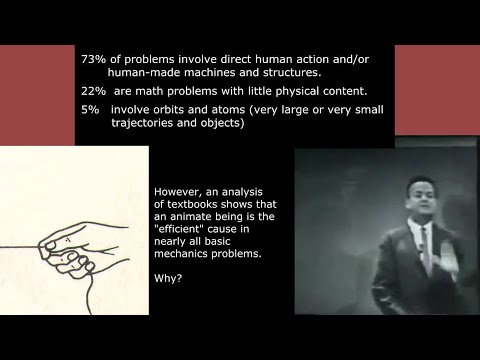
It is interesting to note that in introductory classical mechanics textbooks, the development of the concept of force is completely dependent on motion that is created directly or indirectly by animate beings, with human made machinery and structures being the primary source of all examples and problem sets.
The textbooks define force as a "push/pull, then proceed to gradually depersonalize the concept, moving from a person's everyday experiences, to the image of a disembodied hand, to the abstract mathematical concept of a vector.


0 Comments